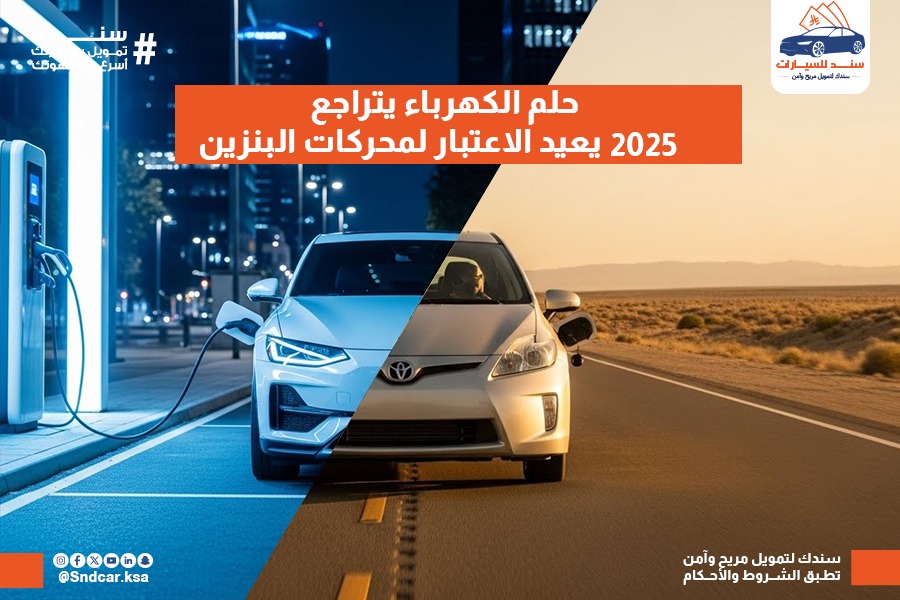
The dream of electricity fades… 2025 restores the appeal of gasoline engines
The Electric Dream Fades… 2025 Revives Gasoline Engines
At the beginning of 2024, a single refrain dominated the automotive industry: goodbye to gasoline. Optimistic reports, massive investments, and decisive statements suggested that electricity was the only path to the future.
But as 2025 approached, the landscape changed dramatically. Not only did the expansion of electric vehicles stall, but major automakers began to reassess their strategies and gradually shift towards internal combustion and hybrid engines, in an implicit admission that the “electric dream” had outpaced reality.
The most important question today is no longer: When will gasoline disappear?
Instead: Why hasn't it disappeared despite all this pressure?
1️⃣ Slowing Sales… When Consumers Speak Out
The biggest blow to the electric vehicle shift came not from governments, but from the market itself.
Quite simply, consumers weren't as enthusiastic as expected.
The emergence of cars like the Fiat 500 hybrid with a traditional transmission reaffirmed an important truth:
People are still looking for simplicity, reliability, and a sense of complete control, not complex technological solutions that impose a new driving style.
By 2025, the return of the third pedal and manual transmission will no longer be a shock, but rather a clear message that "experience" is just as important as "technology."
2️⃣ Ford Pays the Price… and Those Who Learn Survive
The electric transformation has been costly not only psychologically, but also financially.
Ford's decision to discontinue production of its electric F-150 Lightning truck came as a shock, especially after operating losses estimated at around $19.5 billion in just a few years.
In contrast, other companies have chosen a more flexible approach:
Mercedes introduced its new CLA multi-drive platform.
The same car can run on gasoline, hybrid, or electric power depending on market demand.
The lesson here is clear:
The market doesn't reward extremism… it rewards flexibility.
3️⃣ Infrastructure and Range: Why is Saudi Arabia a Special Case?
In the Saudi market, the picture is clearer.
Despite significant progress in sustainability projects within Vision 2030, there remain real challenges that cannot be ignored:
🔹 Long Distances
Journeys such as Riyadh-Jeddah or Eastern Province-Riyadh make “range anxiety” a crucial factor.
🔹 Fast Charging
The scarcity of high-capacity charging stations on highways makes gasoline cars the safest option for travelers.
🔹 Climate
High temperatures reduce battery efficiency and increase energy consumption for cooling, reducing the actual range by up to 30%.
In this context, the Saudi consumer's continued reliance on gasoline engines is not a traditional choice, but a rational one.
4️⃣ Synthetic Fuels (E-Fuels): The Winning Card
Real transformation doesn't always happen through radical change, but sometimes through development.
This is where low-carbon synthetic fuels emerge as a smart, game-changing solution.
Saudi Aramco plays a pivotal role in this area, through investments aimed at:
Reducing emissions.
Maintaining the current architecture of combustion engines.
Enabling a sustainable transition without drastic losses.
This approach explains:
Porsche's continued development of combustion engine versions of the Macan and Cayenne.
The European Union's reversal of its 2035 ban on electric vehicles, opening the door to synthetic fuel cars.
In other words:
You can keep your current car… and achieve your sustainability goals at the same time.
5️⃣ Incentives are decreasing… and the economic equation is shifting.
In markets like the UK, governments have begun reducing subsidies:
Additional charges on electric vehicles starting in 2028.
Higher electricity prices compared to fuel.
In Saudi Arabia, however, the equation is clearer:
Stability of fuel prices.
Availability of spare parts.
Extensive technical expertise.
Higher resale value.
All of this makes the total cost of ownership of gasoline and hybrid cars more attractive than electric vehicles, which still suffer from depreciation in the used car market.
6️⃣ Hybridization… The Safe Haven for the Automotive Industry
Between the extremes of electric vehicles and the stubbornness of gasoline engines, a safe haven has emerged: hybrid cars.
Luxury companies such as:
Lamborghini
Bentley
BMW (Neue Klasse)
have clearly shifted towards plug-in hybrid solutions.
And in Saudi Arabia, demand has increased for cars like:
Toyota Camry Hybrid
Highlander Hybrid
because they offer:
Fuel efficiency.
Familiar performance.
No range or infrastructure worries.
A Brief Comparison: The Reality in Numbers
Element
Gasoline / Hybrid
Fully Electric
Fueling Time
3–5 minutes
30–60 minutes
Actual Summer Range
600–800 km
Decreased by 20–30%
Resale Value
High and Stable
Low
Maintenance Efficiency
Very Wide
Limited
Initial Cost
Competitive
High
Conclusion: Is the Electric Dream Over?
No… but it has matured.
Electricity hasn't failed, but it has moved from the stage of enthusiasm to the stage of realism.
The future of 2025 doesn't belong to a single engine, but to a world of multiple solutions:
Electricity for cities.
Hybrid for everyday use.
Gasoline-powered with clean fuel for long journeys.
And in this landscape, the traditional engine remains present, smarter, and closer to the reality of the Saudi consumer.
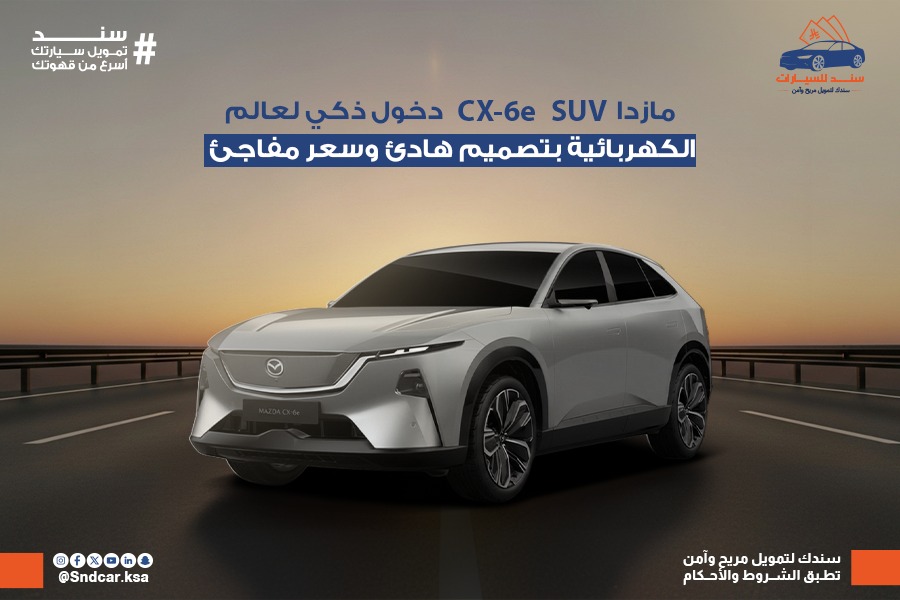
In a move that reflects Mazda’s gradual transition toward an electric future, the company has officially unveiled the Mazda CX-6e
Posted on 2026-01-24 04:04 PM